Fill Out a Valid West Virginia Cf 1 Template
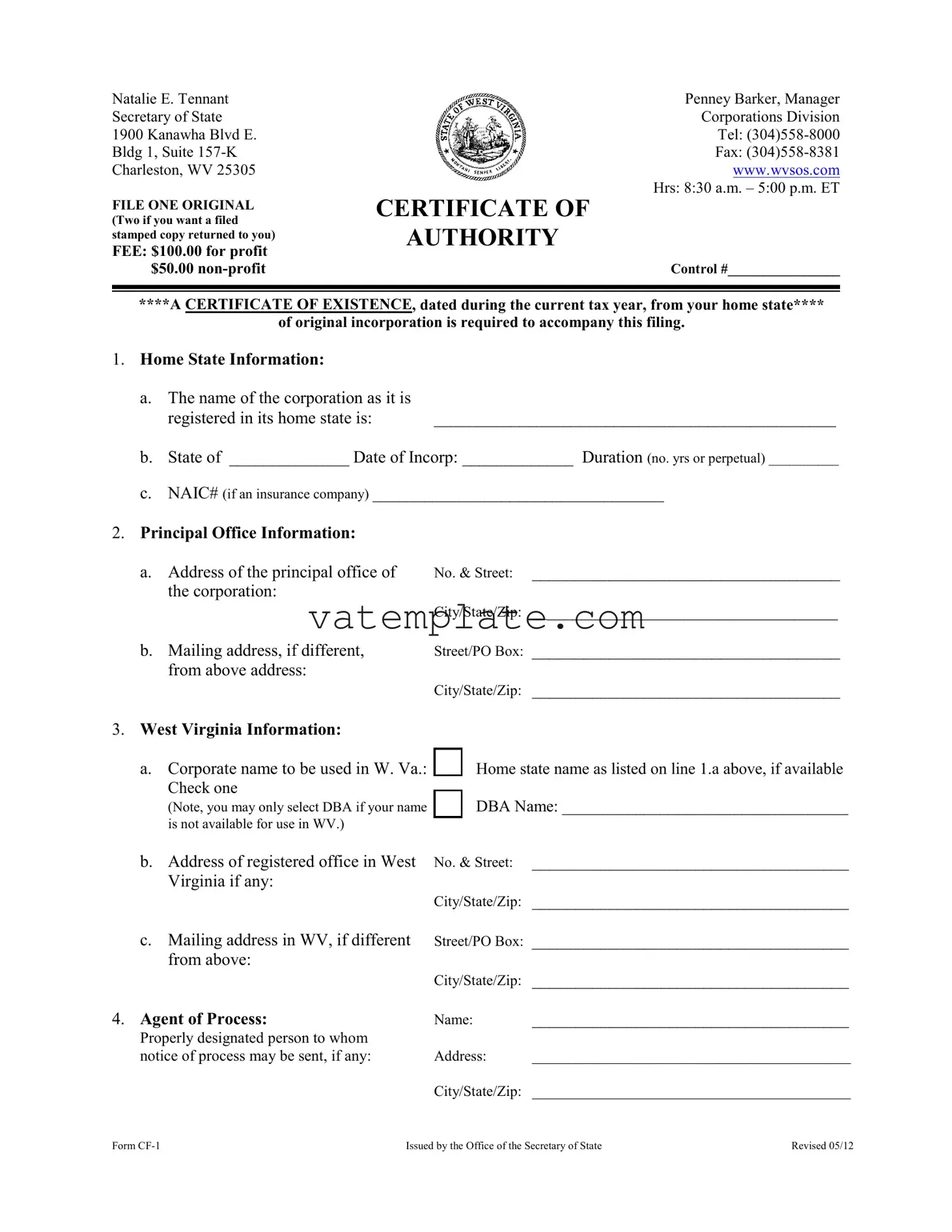
In the bustling state of West Virginia, businesses seeking to formalize their presence encounter the CF-1 form, a cornerstone in the establishment process guided by the Secretary of State, Natalie E. Tennant. The form serves as an Application for Certificate of Authority, playing a crucial role for entities aiming to extend their operations within this jurisdiction. Notable for its meticulous requirement of a Certificate of Existence from the home state, the form meticulously lays out sections for home state information, principal office details, and specific West Virginia information, ensuring that businesses are well-aligned with local regulations. It distinguishes between profit and non-profit entities, mandating a fee that reflects this distinction. The form also addresses the designation of a registered agent, an indispensable requirement for maintaining an effective line of communication for legal processes. Furthermore, it opens a dialogue for the business’s purposes in West Virginia, potentially including, but not limited to, those venturing as Scrap Metal Dealers. With operational hours between 8:30 a.m. and 5:00 p.m. ET, the Corporations Division under Manager Penney Barker offers extensive support, emphasizing the importance of accuracy in submitting the CF-1 form for a smooth transition into West Virginia’s business landscape.
West Virginia Cf 1 Example










Form Properties
| Fact | Detail |
|---|---|
| Form Name and Purpose | The West Virginia CF-1 form, also known as the Application for Certificate of Authority, is utilized by corporations seeking authorization to conduct business in the state of West Virginia. |
| Issuing Authority | The form is issued by the Office of the Secretary of State of West Virginia, with the contact being the Corporations Division managed by Penney Barker. |
| Fee Structure | The filing fee for the application is $100.00 for profit corporations and $50.00 for non-profit corporations. |
| Submission Requirements | Applicants must file one original application, with the option to submit two if they wish to receive a filed stamped copy in return. A Certificate of Existence or Good Standing from the corporation's home state, dated within the current tax year, must accompany the application. |
| Governing Law | The process and requirements for the Certificate of Authority are governed by the West Virginia Business Corporation Act, specifically, for insurance companies, compliance with WV Code §33-1-12 and §33-3-3 is mandatory regarding the naming provisions and requirements for a certificate of incorporation issued by the West Virginia Insurance Commissioner. |
Steps to Filling Out West Virginia Cf 1
After deciding to expand or establish a corporation's presence in West Virginia, completing the Application for Certificate of Authority (Form CF-1) is a crucial step. This process involves providing detailed information about the corporation's structure, purpose, and points of contact within the state. Each section of the form requires attention to detail to ensure that the corporation complies with West Virginia state regulations. Below are structured steps designed to guide through the filling process efficiently.
- Ensure the corporation's name is available in West Virginia by contacting the Secretary of State's office. If the name is not available, secure a DBA (Doing Business As) name by submitting a board resolution.
- Obtain a Certificate of Existence or Good Standing from the home state of incorporation, ensuring it's dated within the current tax year.
- Under Section 1: Home State Information, fill in the corporation's name as registered in its home state, state of incorporation, incorporation date, and duration.
- For insurance companies, include the NAIC number in the designated field.
- In Section 2: Principal Office Information, provide the address of the principal office and, if different, the mailing address.
- Under Section 3: West Virginia Information, indicate the corporate name to be used in West Virginia. Include the address of the registered office in WV, and if different, the West Virginia mailing address.
- In Section 4: Agent of Process, designate a person or business as the agent to whom legal notices are to be sent, along with their contact information.
- Section 5 asks for a brief description of the corporation's proposed business activities in West Virginia.
- If applicable, complete the question in Section 6 regarding Scrap Metal Dealer status and provide the necessary additional form.
- Provide a valid e-mail address and, if available, the business website address in Sections 7 and 8.
- For Section 9: Corporate Status Information, indicate whether the corporation is for-profit or non-profit and list the officers and directors.
- In Section 10, state the amount of land the corporation holds or expects to hold in West Virginia.
- The Section 11: Contact and Signature Information requires the contact name and phone number, as well as the printed name, title/capacity, and signature of the person authorized to sign the form.
- Review the application thoroughly to ensure all provided information is accurate and complete.
- Assemble the application packet to include the Certificate of Existence/Good Standing, the completed CF-1 form, a board of directors' resolution if using a DBA name, any required additional forms for scrap metal dealers or insurance companies, and the filing fee ($100 for profit corporations, $50 for non-profits).
- Mail or deliver the completed packet to the Secretary of State's office at the address provided at the top of the form.
Once the application and all accompanying documents are submitted, the Secretary of State's office will review the materials. If the application is approved, the corporation will receive its Certificate of Authority to transact business in West Virginia. It's important to wait for this approval before commencing any business activities in the state. Should there be any issues with the filing, the office will reach out using the contact information provided on the form.
FAQ
What is the CF-1 form used for in West Virginia?
The CF-1 form, also known as the Application for Certificate of Authority, is utilized by corporations seeking to register to do business in the state of West Virginia. This document is essential for out-of-state (foreign) corporations to legally operate within West Virginia, ensuring they comply with state regulations and tax obligations.
Who needs to file a CF-1 form?
Any foreign corporation intending to transact business in West Virginia needs to file a CF-1 form. This includes both for-profit and non-profit entities. The requirement is part of the state's efforts to regulate and monitor business operations, ensuring compliance and fairness in commerce.
What documents are required to accompany the CF-1 form?
To successfully submit the CF-1 form, corporations must include:
- A Certificate of Existence or a Certificate of Good Standing from the corporation's home state, dated during the current tax year.
- If applicable, a copy of the Certificate of Authority issued by the West Virginia Insurance Commissioner or a written approval of the charter for insurance companies.
- For scrap metal dealers, the completed Scrap Metal Dealer Registration Form (Form SMD-1).
Is there a filing fee for the CF-1 form?
Yes, there are filing fees associated with the CF-1 form. The cost is $100.00 for for-profit entities and $50.00 for non-profit entities. These fees support the administrative costs of processing the applications and maintaining records.
How can a corporation check if its name is available in West Virginia?
Before submitting the CF-1 form, corporations should verify the availability of their name in West Virginia by contacting the Secretary of State's office at (304) 558-8000. Alternatively, preliminary information can be obtained through the Secretary of State’s website. If the name is available, it can be reserved for 120 days with the submission of an application and a $15 fee.
What if the corporation's name is not available in West Virginia?
If the corporation's home state name is not available in West Virginia, the corporation must adopt an available fictitious name (DBA - Doing Business As) for use in the state. This requires a resolution from the corporation's board of directors adopting the fictitious name, which must be attached to the CF-1 form submission.
Can the CF-1 form be filed electronically?
The instructions do not specify an electronic filing option. Therefore, to file the CF-1 form, the corporation should mail or deliver the required documents as a packet to the Secretary of State’s office at the address provided in the form instructions.
What is the role of the registered agent listed in the CF-1 form?
The registered agent acts as the corporation’s representative for receiving legal notifications, including service of process. The agent can be an individual or a business entity and is responsible for forwarding any official communications to the corporation. This role is crucial for ensuring the corporation can be legally contacted and held accountable within the state.
How long does it take to process the CF-1 form?
The processing time can vary based on several factors including the current workload and the completeness of the application. For the most up-to-date information regarding processing times, contacting the Secretary of State's office directly is recommended. Expedited service options may also be available for an additional fee.
Common mistakes
When filling out the West Virginia CF-1 form, people often make mistakes that can delay the process of registering a corporation. It's crucial to pay close attention to detail and follow the instructions carefully to avoid common pitfalls. Here are six mistakes to watch out for:
- Not checking name availability: One of the most frequent errors is selecting a corporate name without verifying if it's distinguishable and available for use in West Virginia. This oversight can lead to the rejection of the application.
- Incorrectly listing the principal office address: Applicants sometimes enter the wrong address for the principal office or forget to mention if the mailing address differs from the principal office address, which can lead to communication issues.
- Forgetting to include a Certificate of Existence: A current Certificate of Existence from the home state of original incorporation is required. Missing or outdated certificates are common mistakes that can prevent the application from being processed.
- Failure to specify the type of corporation: The form asks whether the corporation is for-profit or non-profit. Overlooking this section or marking the incorrect option can lead to filing issues.
- Omitting required information about officers and directors: Shifting through the list of necessary details, applicants sometimes skip adding comprehensive information about the officers and directors, including their titles and addresses.
- Incorrectly listing the purpose of business: Providing vague or incorrect information about the proposed purpose(s) for transacting business in West Virginia can also lead to the application being deferred for clarification or correction.
Being thorough and attentive when completing the West Virginia CF-1 form is key to a smooth filing process. Avoiding these common mistakes can save time and help ensure that your corporation is properly registered without unnecessary delays.
Documents used along the form
When entering the business landscape in West Virginia, particularly when filing the CF-1 Form for registering a business from another state, several essential documents support the smooth execution of this process. Understanding what these documents are and their purpose not only streamifies the registration but also helps in maintaining compliance with West Virginia state law.
- Certificate of Good Standing: This document from the home state declares that a corporation is in compliance with local regulations and is up-to-date on all filings and fees. It's essential for proving the legal status of your corporation for the CF-1 Form.
- Articles of Incorporation: The foundational charter of a corporation, detailing its structure, purpose, and regulatory compliance methods. It's crucial for certifying the corporation's legitimacy and structure.
- Application for Name Reservation: This form reserves your business name in West Virginia, preventing others from registering it until you're ready to file your CF-1 Form.
- DBA Filing Form: "Doing Business As" forms are required if your business operates under a trade name. This form registers the trade name in West Virginia.
- Form SMD-1 (Scrap Metal Dealer Registration Form): Specifically required if the incoming business deals in scrap metal, complying with West Virginia Business Code §61-3-49-(b)(4).
- Board Resolution for DBA Name: If using a different name in West Virginia than the original corporation name, a formal resolution adopting the fictitious name must be included.
- Professional License or Registration Proof: If your business is in a regulated profession (like engineering), proof of professional licensure or registration in West Virginia or a statement of eligibility must be included.
- Insurance Certificate: For certain businesses, particularly those that are insurance-related, a current certificate of insurance must be submitted to comply with sector-specific regulations.
: Specifically for insurance companies, presenting this approval alongside your CF-1 Form is crucial to showcase compliance with local insurance laws and regulations.
Each of these documents plays a pivotal role in ensuring that businesses transitioning into West Virginia do so with full compliance, minimizing legal hurdles and facilitating a smoother operation within the state. Being prepared with the necessary paperwork not only demonstrates a company’s commitment to legal adherence but also paves the way for a successful establishment and future growth in West Miles Virginia.
Similar forms
The West Virginia CF-1 form is similar to Form LLC-1, which is used for the Application for Certificate of Formation for a Limited Liability Company in many states. Both forms are designed to officially register a business entity with the state's Secretary of State office, providing critical information like the business name, principal office address, and the registered agent for legal processes. Additionally, each form requires information about the business's purpose, management structure, and, if relevant, the specific duration of its operations. They also both necessitate a filing fee, although the amount may vary between the different forms and states.
Another document similar to the West Virginia CF-1 form is the Form NP-1, which is commonly used for Non-Profit Corporation Applications for Certificate of Authority across various states. Like the CF-1, the NP-1 gathers essential information about the corporation, including its name, principal and West Virginia office locations, registered agent, and the purposes for which the non-profit aims to operate within the state. Both forms also require certification from the home state, such as a Certificate of Good Standing or Existence, dated within the same tax year as the application. This certification confirms that the business or non-profit is currently authorized to conduct its activities in its home state, a requirement for being granted similar privileges in West Virginia.
Dos and Don'ts
When filling out the West Virginia CF-1 form, an essential document for registering a corporation's authority to do business in the state, attention to detail is crucial. The following guidelines will help ensure that the process is completed correctly and efficiently, avoiding common pitfalls that could delay your filing.
Do:
- Ensure the corporation's name is listed exactly as it appears on the good standing certificate from the home state. Accuracy in the match between these documents is paramount.
- Provide a Certificate of Existence or Good Standing dated within the current tax year from the state of original incorporation. This document is essential for proving the legal status of your corporation.
- Check the availability of your corporation's name in West Virginia before filing. Name uniqueness prevents confusion and is required by the state law for registration approval.
- If applicable, attach a resolution from your board of directors adopting a fictitious name (DBA) if your home state name isn’t available in West Virginia. This step is crucial for compliance and to proceed with business under an alternative name.
Don't:
- Forget to list the NAIC number if you're registering an insurance company. West Virginia requires this information for insurance companies to ensure compliance with specific industry regulations.
- Overlook the need to specify the correct corporate suffix (such as “Inc.” or “Corp.”) when listing your corporation's name, especially if your home state name does not include one. This detail is essential for legal and formal recognition.
- Ignore the instructions regarding the submission of two originals if you want a filed stamped copy returned to you. Keeping a conformed copy for your records is always a prudent practice.
- Leave the section for the proposed purpose(s) for transaction of business in West Virginia blank or vague. Being concise and clear in this section is necessary for clarifying your business activities to the state.
Compliance with these dos and don'ts not only facilitates a smoother application process but also helps avoid unnecessary delays or rejections by the West Virginia Secretary of State's office. Being thorough and meticulous in completing the CF-1 form sets a solid foundation for your corporation's business ventures within the state.
Misconceptions
When dealing with the West Virginia CF-1 form, used to apply for a Certificate of Authority for corporations to transact business in the state, there are several common misconceptions that need to be addressed for a smoother filing process:
- Misconception #1: Any corporation, regardless of its home state status, can use its original name in West Virginia. This is incorrect because the corporate name must be distinguishable from other names already on file with the Secretary of State. If the original name is not available, a DBA (Doing Business As) name must be adopted.
- Misconception #2: The filing fee is the same regardless of the corporation's status. In reality, the fee is $100.00 for profit corporations and $50.00 for non-profit corporations.
- Misconception #3: The Certificate of Authority is optional. Actually, obtaining this certificate is a legal requirement for out-of-state corporations intending to do business in West Virginia.
- Misconception #4: Electronic submission is available for the CF-1 form. Currently, submissions must be mailed or delivered in person to the Secretary of State's office.
- Misconception #5: The CF-1 form serves as a one-time requirement. However, other conditions and reports may need to be filed annually to maintain good standing in the state.
- Misconception #6: A Certificate of Good Standing from the corporation's home state is not required. On the contrary, a current Certificate of Existence or Good Standing from the home state must accompany the CF-1 form.
- Misconception #7: The same application form is used for both for-profit and non-profit corporations. This is true, but the application clearly differentiates between the two, and different information may be required based on the corporation type.
- Misconception #8: The CF-1 application process does not accommodate changes to corporate information. In reality, any changes to corporate names, addresses, or agent information must be communicated and may require additional forms or fees.
- Misconception #9: All corporations are subject to the same review process. Specific corporations, especially those in regulated industries such as insurance, may require additional approvals or documentation from respective state commissioners or boards.
Understanding these misconceptions and preparing accordingly can help ensure a smoother filing process for obtaining a Certificate of Authority in West Virginia.
Key takeaways
When businesses seek to operate within West Virginia, the West Virginia CF-1 form serves as a crucial initial step. This application for a Certificate of Authority is designed to ensure that entities are legally recognized to conduct business within the state. Here are four key takeaways to keep in mind:
- When filling out Section 1 of the form, the name of the corporation must exactly match the name as it appears on the Certificate of Existence or Good Standing issued from its home state. This is a foundational step that ensures consistency and legal recognition across state lines.
- In case the corporation’s name from the home state is not available in West Virginia, or does not meet state requirements (including use of specific words indicating its business nature), the entity is required to adopt a fictitious name (DBA - Doing Business As) for its operations within the state. This process includes submitting a resolution from the board of directors approving the use of this alternative name.
- The designation of an agent for the service of process is not only a requirement but a protective measure for the corporation. This agent is responsible for receiving legal documents on behalf of the corporation. It is important to provide accurate details of the agent, which includes their full name and address, ensuring that they are readily available to perform this critical role.
- The application fee varies depending on the nature of the corporation, with for-profit entities being charged $100.00 and non-profit entities $50.00. This distinction emphasizes the state’s approach to categorizing entities based on their operational purpose and provides a scaled fee structure accordingly. Additionally, entities intending to hold real estate in excess of certain thresholds in West Alive are subject to additional fees, reinforcing the need for comprehensive disclosure.
It is paramount for entities to thoroughly complete the West Virginia CF-1 form, adhering to specific instructions and requirements detailed in the guidance. Each section of the form collects vital information that aids the state in understanding the scope, nature, and details of the business intending to operate within its jurisdiction. The completion of this form, backed by the necessary documentation and fees, paves the way for smooth registration and compliance with West Virginia’s regulatory framework.
Other PDF Forms
Virginia Sales Tax Exemption - Empowers authorized officials to certify tax exemption eligibility, reinforcing the responsible use of the privilege.
Filing Status 3 - Inclusion of adjustments for late filing penalties ensures that taxpayers account for additional liabilities owed to the state.
-9+r=5 - Nonresident sellers of real estate in Virginia use this form to document the sale and ensure compliance with state tax regulations.